How the Film Nashville Changed Nashville Forever

Updated: Jul 10
By Paul Whitten, Founder of Nashville Adventures
In 1975, long before bachelorette pedal taverns and neon Broadway, Nashville was captured on film in a way the city had never seen before. The movie Nashville arrived at a moment when the city was still a regional music town, not yet a global brand. The film did not just depict Nashville. It reshaped how the rest of the country saw it and, in many ways, how Nashville came to see itself.
Nearly fifty years later, locals still argue about it, filmmakers still study it, and historians still point to it as one of the most important American movies ever made. This is the story of how Nashville became more than a film and turned into a cultural turning point for the city itself.
Nashville the Movie and Nashville the City in 1975
When Nashville was released in 1975, Nashville was not chasing tourists. Broadway was gritty. Music Row was powerful but insular. The city felt more like a company town for the music industry than a destination.
Director Robert Altman arrived with a radically different approach to filmmaking. He used overlapping dialogue, loose scenes, and a massive ensemble cast of 24 main characters. Many actors wrote their own songs. Large portions of the film were shot on real streets, in real venues, with real Nashvillians walking through scenes.
That mattered. Nashville was not polished for the camera. It was honest, loud, uncomfortable, and sometimes chaotic. That authenticity shocked audiences who expected a glossy love letter to country music.
Instead, they got something much deeper.
A Film That Used Music to Talk About America
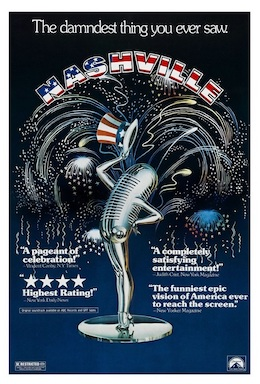
Although the movie is named after the city, Nashville is really about the United States in the mid-1970s. The Vietnam War had just ended. Watergate was fresh. Trust in institutions was collapsing. Music, politics, fame, and ambition were colliding in uncomfortable ways.
Altman used Nashville as a stand in for the nation. Country music was no longer just regional. It was becoming political, commercial, and national.
From a film history standpoint, Nashville now sits alongside the most important American films of the decade. It earned multiple Academy Award nominations and still appears on best of all time lists.
But here is the local truth. Nashville did not immediately embrace it.
How Locals Reacted Then and Why That Changed
For many Nashvillians in the 1970s, the film felt like a critique rather than a celebration. Some felt it made the city look cynical. Others thought it exaggerated the industry’s flaws. Country musicians were especially divided.
Over time, locals began to recognize something important. The movie preserved a version of Nashville that no longer exists.
You see Lower Broadway before its transformation. You hear the tension between traditional country and commercial ambition. You feel a city wrestling with growth before growth became inevitable.
As a Nashville historian and someone who walks these streets almost daily, I can tell you this. When longtime locals talk about old Nashville, they are often unknowingly describing scenes straight out of this film.
Nashville’s Place in Cinema History
From a cinema perspective, Nashville did three major things that still ripple today.
First, it proved that a city could be a character, not just a backdrop.
Second, it influenced generations of filmmakers who embraced ensemble storytelling, realism, and imperfect humanity.
Third, it cemented Nashville as a serious cultural subject. Not just music. Not just entertainment. But identity, politics, and American storytelling.
This is why film schools still teach it. This is why critics still debate it. And this is why Nashville’s reputation quietly expanded far beyond country radio.
Rediscovered Through Breakdown 1975

In recent years, Nashville has found new life through modern documentaries that revisit the cultural shockwaves of the mid 1970s. One of the best is Breakdown 1975, which explores how a single year reshaped music, film, politics, and American identity.
The documentary places Nashville exactly where it belongs. Not just as a movie, but as a cultural artifact of a country trying to understand itself.
On a personal note, I loved this documentary. It does an excellent job connecting the dots between what was happening on screen and what people were feeling in real life. Watching it, you realize that Nashville was not ahead of its time. It was painfully on time.
For new viewers discovering the film through Breakdown 1975, the reaction is often the same. This does not feel dated. It feels familiar.
Why the Film Still Matters in Modern Nashville

Modern Nashville likes to brand itself as Music City USA, but the deeper truth is that the city has always been a mirror of America’s cultural tensions.
Nashville captured that moment on film.
The merging of politics and entertainment. The cult of personality. The commodification of authenticity. Nashville was grappling with all of it decades before it became national conversation.
That reputation attracted artists, filmmakers, and thinkers who wanted something more complex than a postcard version of the South.
In many ways, the Nashville boom did not start with tourism boards or social media. It started with storytelling.
Seeing the Film’s Legacy on the Streets Today
If you know where to look, the movie is still everywhere.
The politics and music crossover. The tension between industry and artistry. The way Broadway is both a stage and a workplace. These are themes we still talk about on our tours.
On our Nashville History Walking Tour, we often discuss how the city reinvented itself again and again. Nashville is one of those reinvention moments. It froze a city in time just before everything changed.
Final Thoughts from a Local Historian
I have lived in a lot of places and studied history professionally. Few films understand place the way Nashville does.
It did not flatter the city. It respected it.
That is why, fifty years later, the film still matters. Not just to cinephiles, but to anyone who wants to understand why this city feels the way it does.
If you want to see where old Nashville met new Nashville, we would love to walk you through it. Some stories are better told on foot, right where they happened Want proof? Take our Nashville walking tour which is designed to show the city as it actually is. Led by a local historian, each tour connects the places you see to the stories that shaped Music City.

