The Real History of Southern Food, and the Charleston Restaurant I Never Forgot

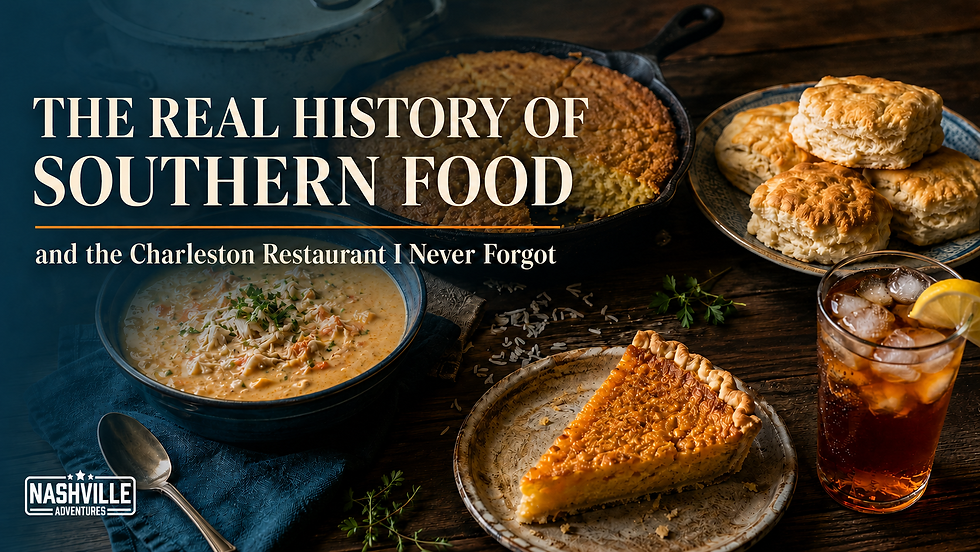
A few weeks back, The Daily Meal reached out while they were building a piece on the classic foods invented in the South. They wanted a historian in the mix. I said yes, because this is the stuff I love talking about, and because most people have no idea how much real history is sitting on their plate. The article is live now, and I am honored to be quoted in it as a historian, right alongside working chefs and food writers who know their craft. You can read the whole thing on The Daily Meal.
The short version of what I told them is simple. Southern food is not a set of cute regional recipes. It is a record of who was actually in the kitchen.
What I Actually Told Them

They asked about the dishes everyone thinks they know. Here is some of what I said.
On she-crab soup, the Charleston classic, I did not sugarcoat it. "Most of what gets sold as she-crab soup today has no roe in it." And the origin story people repeat is usually wrong. As I put it in the article, "The cooking came from a Black chef whose name most people ordering the soup have never heard."
On sweet tea, which folks treat like it fell out of the sky, "Imported tea, refined sugar, and ice were all expensive. Sweet tea was a flex." It was a way to show you could afford all three at once.
On Brunswick stew, the dish two states still fight over, the man who made it famous was not the man who got the credit. "The man actually standing over the pot was Jimmy Matthews, an enslaved cook working for Dr. Creed Haskins."
And chess pie, my favorite line I gave them:
Chess pie is the most Southern pie there is, because it is the pie you make when there is nothing in the house.
That is the thread through all of it. So much of Southern cooking came from enslaved West Africans who were bought, as I told the magazine, "specifically from the Rice Coast of West Africa, Senegambia, and Sierra Leone for their expertise." You can still trace that lineage today through the Gullah Geechee Cultural Heritage Corridor. The food survived. The names mostly did not. Putting them back is part of the job.
The Fleet Landing Coincidence

Here is the part that made me laugh out loud (for real... an actual LOL)
One of the other experts quoted in the same article is Andy McLeod, the executive chef of Fleet Landing in Charleston.
If you have never been, Fleet Landing sits right on the water in an old naval building. I know the place. I spent my cadet years in Charleston, and I was about as cynical as a young cadet can get. Fleet Landing was the spot that cracked that open. It is still my favorite restaurant anywhere, and that one is not up for debate.
So the odds that I would land in the same national food article as the chef running the kitchen at the one restaurant I would drive back to Charleston for, that is a funny piece of luck. I doubt Chef McLeod knows some Nashville tour guide has been talking up his she-crab soup for years. Now we are on the same page in print. Small world, good food.
Why This Is Exactly What We Do
This is the whole reason our tours are what they are. When you take a Nashville walking tour with us, you are not getting a list of dates and a couple of fun facts. You are getting the real story, the good and the uncomfortable, told by people who actually study it. Food, music, war, whiskey, it all connects.
If you want the version of Nashville that most guides skip, that is our lane. Come walk with us. Take a look at our Civil War tour or the full tour lineup and pick your history.
And if you find yourself in Charleston, go to Fleet Landing. Order the she-crab soup. Ask if it has roe in it. Tell them the historian from Nashville sent you.


