The Nashville Symphony Is in Crisis. Here Is My Unpopular Take.

By Paul Whitten, Founder of Nashville Adventures
Update, October 5, 2026: Right after I wrote this, Oracle stepped in with a ten million dollar gift that saves the season and cancels the furloughs. Genuinely good news, and I am thrilled for the musicians. Job continuity is always nice. However, it also does not change my argument one bit, and I have folded the update in below.
I love the Nashville Symphony. I need you to hear that before I say anything else, because what follows is going to sound like I do not.
I have sat in the Schermerhorn three times in my life, and all three times I enjoyed being there. I saw the Dolly show, I saw a movie with the symphony playing behind, and another show with Irish music (I forget exactly). It was world class. Truly.
But... I run a business. And when I look at what just happened to the Nashville Symphony, the business part of my brain will not stay quiet. So here is my honest, unpopular take.
What Actually Happened to the Nashville Symphony
Let us start with the facts, because they are brutal.
On September 28, 2026, the Symphony's board voted unanimously to declare a financial emergency and suspend the entire 2026 through 2027 season. The organization is staring down a roughly ten million dollar deficit and has, in plain terms, run out of cash. Seventy seven orchestra musicians and twenty seven staff members were furloughed. The newly hired president and CEO, J. Mark Cantrell, announced the suspension and then resigned about a day later.
Here is how Cantrell put it, and it is about as blunt as a nonprofit ever gets:
The organization has exhausted its cash and cannot continue operating as it has. (via Nashville Scene)
A big part of the collapse, by multiple accounts, was an over-reliance on a single major donor whose support ended this year. One patron. When that pillar went away, the whole model wobbled. Hold that thought, because it is the heart of my argument.
The Oracle Lifeline: A Smart Save That Does Not Fix the Problem
Then, on October 4, 2026, a week after the board pulled the plug, Oracle rode in with a ten million dollar gift. The season is back on. The furloughs are off. The musicians keep their jobs. Let me say the obvious part first: that is genuinely good news, and I am thrilled for the people who just got their livelihoods back.
Here is how the Symphony framed it:
Oracle's extraordinary ten million dollar gift means our season will resume and the announced furloughs of our musicians and full-time staff will not occur. (via WSMV)
And for Oracle, it genius. The company is planting an enormous new headquarters campus on the Nashville riverfront, and ten million dollars is close to a rounding error that buys an ocean of local goodwill right as it moves to town. If I were advising Oracle, I would have told them to write that check too. Smart business, good citizenship, a real win for their name here. They bought a good first impression for Nashville.
But here is the thing a rescue cannot do. It does not make the symphony make money.
This is the exact same model I was just criticizing, with a new name on the check. Last time the single pillar was one family. This time it is one corporation. A ten million dollar gift today buys a year, maybe a few, not a fix. The ticket revenue still does not cover the cost. The hall is still downtown. The debt clock still ticks toward 2035. We did not solve the problem, we refinanced it with better PR.
And yes, the Nashville Symphony's impact on this city is real, unique, and worth protecting. I will say that as many times as it takes. But that impact does not live in the zip code. Move the same orchestra, the same players, the same programming into a building the organization can actually afford, and Nashville gets every bit of the same cultural benefit at a fraction of the risk. A gift keeps the lights on. It does not answer the only question that matters, which is whether this thing can stand on its own.
So thank you, Oracle, sincerely. You bought the Symphony some time. I just hope somebody uses that time to fix the machine instead of waiting on the next emergency.
The Building Keeps Trying to Sink the Ship
Now let me say the quiet part out loud. The problem is not only the budget. It is the address.
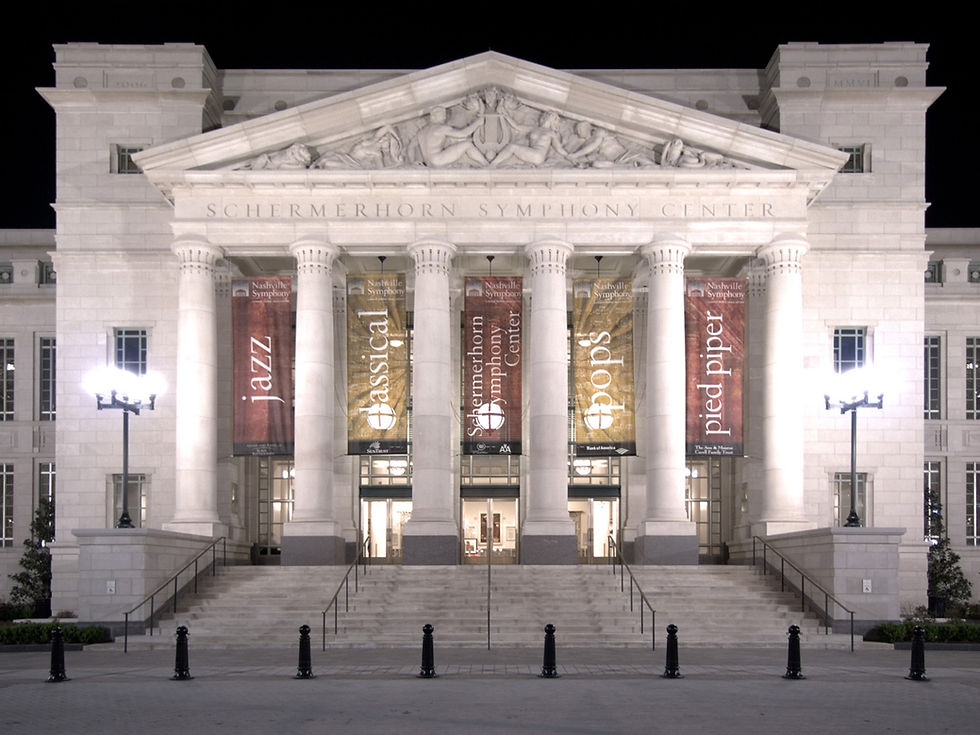
The Schermerhorn Symphony Center opened downtown in 2006, a gleaming limestone concert hall built to announce that Nashville had arrived. And almost from the start, that beautiful building has been a millstone. The 2010 flood did something like forty million dollars in damage to it. In 2013, bondholders actually moved to foreclose on the hall, and it took philanthropist Martha Rivers Ingram stepping in and absorbing roughly twenty million dollars in mortgage debt to stop it. That debt got restructured again in 2026, pushed out to 2035, with the building itself pledged as collateral (WSMV).
Read that history back. Flood, near foreclosure, a rescue by one wealthy family, more debt kicked down the road. The hall is magnificent, and it has spent nearly twenty years trying to drown the organization that plays in it. When your crown jewel is also your anchor, that is not bad luck. That is a structural problem.
My Honest, Unpopular Take
So here is where I lose some friends.
If a business cannot pay its bills, that business has to do something drastically different, or it needs to go away. I do not get to exempt a thing I love from that math, and neither does anyone else. Love ain't a line item.
And I will go further, into genuine weirdo territory. I do not believe grant money and a single mega-donor should be the thing that decides whether a ticket-selling nonprofit survives. The Symphony sells tickets to an experience people enjoy. That is a product. If the product cannot come close to covering the cost of making it, propping it up with one patron's checkbook is not stability, it is life support, and we just watched the plug get pulled when that patron was gone.
Here is the part that really gets me though. We call ourselves Music City, and we are. For country. For bluegrass. For roots, for rock, for jazz, for songwriters, for nearly every genre that gets made by people chasing a living. Classical is the one lane we are simply not known for, and pretending otherwise has never once filled the gap. I wrote about why we are actually called Music City, and Mozart is not in that story. The real history of Nashville's music scene is a tale of fiddles, publishers, and radio towers, not conservatories.
Do I think Nashville deserves a symphony? Absolutely yes. I just do not think it needs to sit on some of the most expensive real estate in the city to earn the right to exist. If that same orchestra played in Donelson, or out in South Nashville near the zoo, or anywhere with a sane cost structure, the music would not sound one note worse. The experience I loved all three times was the playing, not the zip code.
Let Me Argue the Other Side, Because It Is a Good One
I am not so stuck on my own take that I cannot see the case against it. And it is a strong case.
A great city, the argument goes, needs great civic institutions, and the Schermerhorn is genuinely world class, a Grammy-winning orchestra in a hall acousticians rave about. Downtown placement is not vanity, it is accessibility and identity, the beating cultural heart where tourists and locals actually converge. And classical music has leaned on patronage since the Medici. Live orchestral music cannot get more efficient the way a factory can, so a certain amount of subsidy is not a bug, it is simply the economics of the art form. Rip it out of downtown and you gut its donor base and its soul.
That is all true. Here is why I still land where I land.
Patronage is fine. A model that detonates the moment one patron dies is not patronage, it is a single point of failure dressed up in black tie. And yes, orchestras need support, but support should be sized to the audience you actually have, in a building you can actually afford, not strapped to the priciest address in town and a 2035 debt clock. A symphony that believes it must be downtown to matter has quietly confused the real estate with the music.
Then Do Something Drastically Different
The furloughed musicians and the twenty seven staff are the people I feel for here. They are not the problem. They are the ones paying for a model that leadership and boards built around a building and a benefactor.
So fix the model, not the blame. Right-size the footprint. Rethink the room. Lean into the pops, the film scores, the crossover nights that actually sell in this town, and let the heavy repertoire live inside a budget that survives a bad year. The new board chair, Teresa Sebastian, said the goal is a Symphony that is:
not just artistically excellent, but financially strong and sustainable. (via Nashville Scene)
I could not have said it better. I just think financially strong and sustainable might mean leaving the monument behind. Nashville is a city where music is supposed to prove itself on its own merits. I want the Symphony to do exactly that, and I think it can.
Frequently Asked Questions
What happened to the Nashville Symphony in 2026?
In September 2026, the Nashville Symphony declared a financial emergency, suspended its entire 2026 through 2027 season, and furloughed 77 musicians and 27 staff members. The organization faced a roughly ten million dollar deficit and had exhausted its cash reserves, and its newly appointed CEO resigned within about a day of the announcement. In early October, Oracle announced a ten million dollar gift that restored the season and canceled the furloughs.
Did Oracle save the Nashville Symphony?
In October 2026, Oracle announced a ten million dollar gift that allowed the Nashville Symphony to resume its 2026 through 2027 season and cancel the planned furloughs. It rescued the immediate crisis, but it is a one-time infusion rather than a cure for the underlying problem that the orchestra's earned revenue does not cover its costs.
Why is the Nashville Symphony having financial problems?
The Nashville Symphony's troubles stem from rising costs, soft earned revenue, heavy debt tied to the Schermerhorn Symphony Center, and an over-reliance on a single major donor whose support ended in 2026. The downtown hall has faced a 2010 flood and a 2013 near-foreclosure, adding long-term financial pressure.
Could the Nashville Symphony move out of downtown?
Nothing official suggests a move, and leadership is focused on a restructuring plan. But some locals, including me, argue that the orchestra does not need its expensive downtown hall to deliver great music and might be more sustainable with a smaller, cheaper footprint elsewhere in the city.
Is Nashville a classical music city?
Nashville is world famous for country, bluegrass, roots, and songwriting rather than classical music. The city absolutely has an audience for a symphony, but classical has never been the genre that defines Music City, which is part of why the orchestra's business model is so hard to sustain here.
So Tell Me I Am Wrong
Look, I might be. This is an opinion, not a spreadsheet handed down from the mountain, and I would genuinely love to be talked out of it.
Maybe you think a world-class hall downtown is exactly the kind of thing a real city plants its flag on and pays for, full stop. Maybe you are right. But I keep coming back to the same stubborn idea, the one that runs through everything we do over at Nashville Adventures: in this town, music earns its place by connecting with real people, not by owning the fanciest building on the block.
I want the Nashville Symphony to survive. I just want it to survive honestly. Tell me where I have got it wrong.